We have moved past the initial phase of “connecting to AI.” Across the ASEAN enterprise landscape, the conversation has shifted from the excitement of accessibility to the cold reality of a governance vacuum. The relatable problem is now a standard operational risk: a user initiates a complex task, walks away from their desk, and the AI agent continues to work, making autonomous decisions long after the human has disconnected.
Beyond Human Identity: Securing the Rise of AI Agents
Traditional enterprise security is anchored to the concept of a “session”. We authenticate a user, authorize their access, and terminate that access when they log out. AI agents shatter this paradigm. They are designed to operate post-disconnection, functioning as autonomous digital workers that do not sleep and do not require an active browser tab to execute commands.These agents perform high-stakes enterprise actions that carry significant risk:
- Searching and indexing SharePoint directories.
- Executing complex queries against SAP databases.
- Modifying codebases within GitHub repositories.
- Automating workflows across Jira tickets.
- Invoking cascading chains of internal and external APIs, because these actions occur outside of a live user session, traditional controls are fundamentally blind to them. As we integrate advanced telemetry tools to gain visibility, the gap becomes clear: we are trying to manage 24/7 autonomous entities with 9 to 5 security tools. This creates a ‘Ghost in the Machine’ problem where traditional session-based controls no longer provide meaningful protection.
Why Good Authentication Can Lead to Bad Outcomes
We must confront a difficult paradox: the greatest risk to your organization is no longer the external intruder with a stolen password; it is the trusted agent performing a validly authorized but contextually catastrophic action. In this new landscape, identity verification is merely a baseline, not a solution.When a “trusted” agent is granted broad permissions, it can bypass every traditional security layer simply by following a malicious or poorly constructed prompt. Emerging risks that bypass the login screen include:
- Prompt Injection: Silently hijacking an agent’s logic via malicious input to exfiltrate data.
- Over-privileged Permissions: Agents inheriting “God-mode” user rights they don’t actually need for the task at hand.
- OAuth Token Abuse: The silent misuse of tokens to move laterally across SaaS platforms.
- Unrestricted MCP Access: Agents using discovery protocols to find and exploit enterprise tools without oversight.Because authentication and authorization “succeed” in these technical handshakes, security must shift from simple identity verification to runtime policy enforcement .
The AI Gateway is Not Just an API Gateway
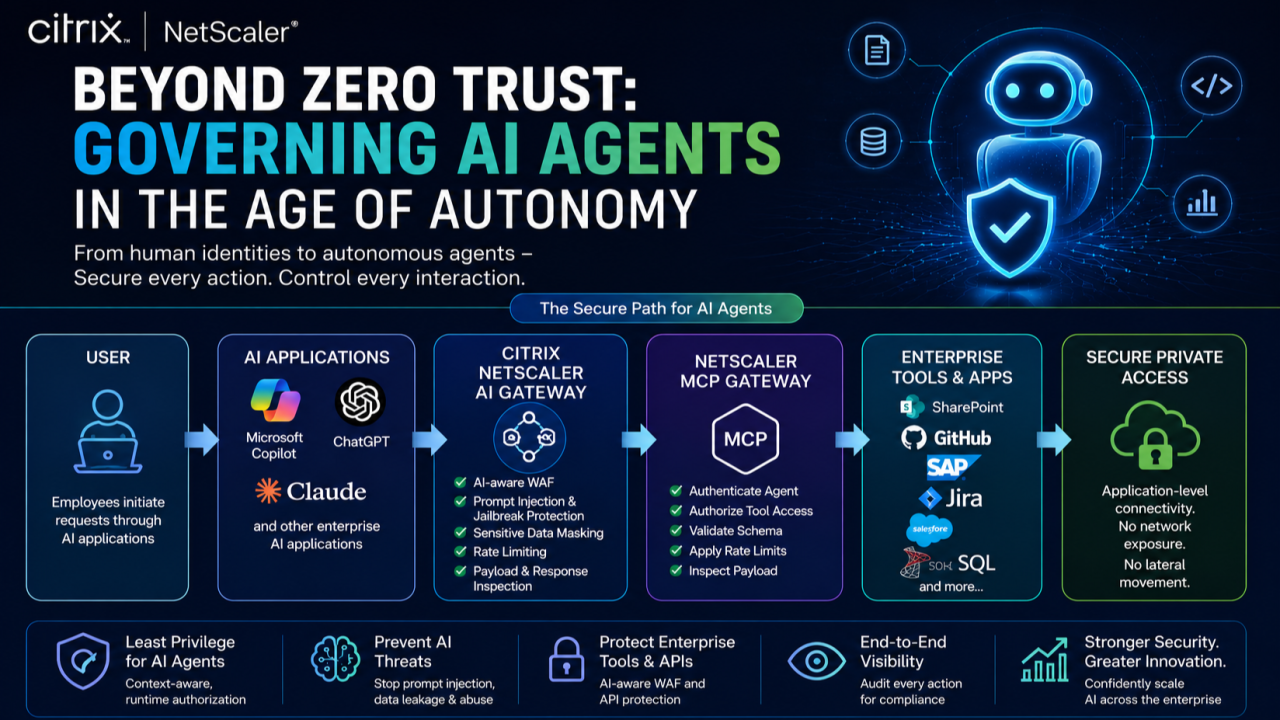
A standard API gateway manages traffic; an enterprise AI Gateway governs intelligence. This specialized control plane sits between your models, your agents, and your business data, evaluating the context of every interaction rather than just the validity of the packet. To provide visibility into the “Ghost in the Machine,” an AI Gateway must answer the questions that traditional firewalls ignore:
- Which specific model is processing this request?
- Who was the original human initiator of this autonomous chain?
- Which specific AI agent is currently acting on our data?
- Is the specific tool (MCP) being invoked authorized for this specific user?
- Does the prompt contain evidence of a jailbreak or injection attempt?
- Is sensitive data or PII being leaked in the model’s response?
Mastering the Model Context Protocol (MCP)
The Model Context Protocol (MCP) is the new “universal remote” for AI. It allows agents to discover and use enterprise tools with unprecedented ease. However, the governance challenge isn’t whether the connection works, but what the agent is allowed to touch once it “discovers” a new tool.A policy-driven gateway must provide a rigorous governance layer over MCP, performing actions such as:
- Agent Identity Validation: Ensuring the agent calling the tool is who it claims to be.
- Payload Inspection: Deep-diving into the data being passed to enterprise systems.
- Schema Validation: Ensuring the agent’s request doesn’t violate the technical constraints of the target application.
- Rate Limiting: Preventing a rogue autonomous agent from inadvertently launching a DDoS attack on internal databases.
The Rise of AI-Aware WAF and Observability
The transition to AI-driven workflows requires a shift from traditional HTTP inspection to AI-aware inspection. This isn’t just about blocking SQL injection; it’s about understanding the intent of a prompt.
- Traditional WAF: Inspects HTTP headers, looks for known exploits (SQLi, XSS), and manages IP reputation.
- AI-Aware WAF: Inspects prompts/responses, detects jailbreaks, masks sensitive data, and validates tokens in real-time.Crucially, this security must be coupled with Citrix SecurAccess ZTNA . By moving away from broad VPNs to application-level access, organizations can ensure an agent only communicates with the specific application it is authorized to touch, drastically reducing the “blast radius” of a compromised agent.This moves security into the realm of the Post-Execution Audit. By integrating with observability platforms like Splunk, ElasticSearch, security teams can finally trace the lineage of an action: Which agent downloaded this file? Which prompt triggered this CRM access? Security is now inseparable from observability.
Conclusion: The Evolution of Zero Trust
Zero Trust is not dead; it is evolving from “who logs in” to “what is the AI doing right now.” The security perimeter has moved from the human identity to the autonomous agent lifecycle.”The future of Zero Trust isn’t just about verifying who logs in. It’s about continuously validating what autonomous AI is doing after the login has already happened.”As you deploy your next generation of digital workers, you must ask yourself: Is your organization still just securing the front door, or are you ready to govern the ghost in your machine?