
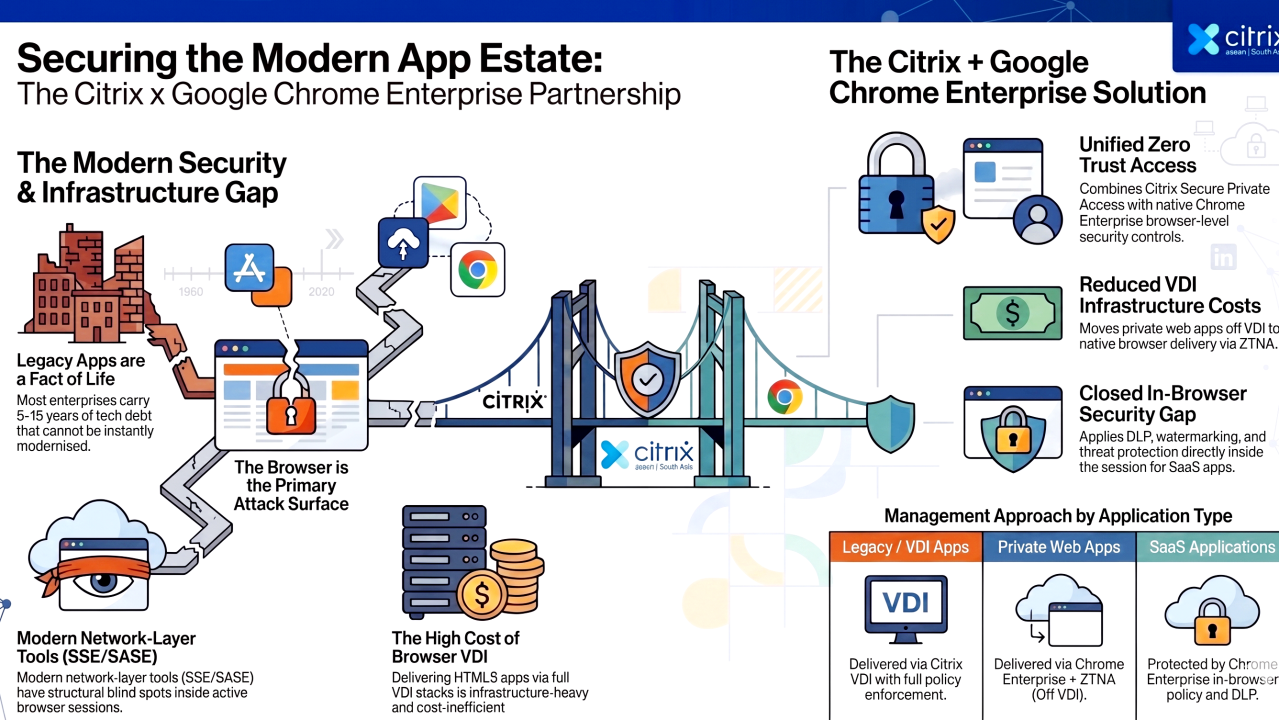
Enterprise security was once built around protecting the corporate network using firewalls, VPNs, and perimeter-based controls. That model worked when applications were hosted on-premises and employees operated from office locations. Today, applications have shifted to the cloud and users work from anywhere on any device. As a result, traditional network-focused security approaches are no longer enough. The browser has now become the primary workspace and the new control point for modern enterprise security.
Your Security Tools are Blind to the Modern Attack Surface
The browser is now the primary attack surface for the enterprise, yet even the “cloud security generation” of Secure Service Edge (SSE) and SASE platforms suffer from a fundamental architectural flaw. These tools are designed to inspect the network connection, but modern threats have moved inside the browser session itself. You cannot solve an in-browser problem with a network-layer tool.
While many leaders believe their current controls provide visibility, several technical and legal shifts have created massive blind spots:
- Encryption and Protocol Shifts: TLS 1.3 and Encrypted SNI have drastically reduced the metadata available to inspection proxies. Furthermore, the rise of Encrypted DNS (DoH) allows browsers to bypass traditional DNS inspection entirely, rendering domain-based threat intelligence useless.
- The Inspection Wall: Certificate Pinning: where applications refuse proxy connections forces organizations to permanently exclude large traffic categories from inspection just to keep the apps from breaking.
- Invisible Exfiltration: Modern Single-page applications (SPAs) render content in the browser after the initial load. Once a proxy approves the initial shell, data exfiltration can occur entirely in-session, hidden from the network layer.
- Post-Network Execution: Malicious browser extensions and injected JavaScript execute within the browser process, occurring after the network layer has already passed the traffic.
- Permanent Legal Blind Spots: In jurisdictions like Germany and across the EU, GDPR, telecoms secrecy laws, and Works Council (Betriebsrat) agreements legally or contractually forbid the inspection of certain traffic, such as personal banking or healthcare. These are not technical hurdles to be overcome; they are permanent gaps that threat actors actively exploit.
Tech Debt is a Reality, Not a Failure
While security blindness is a technical crisis, it cannot be solved by simply “modernizing” every app. Enterprise technology debt is a fact of life, not a failure of leadership. Most organizations carry between 5 and 15 years of application investment that cannot be instantly transitioned to the cloud.
This “mixed estate” is held in place by four primary drivers:
- Commercial Dependency: Vendor contracts and support licensing lock IT into delivery timelines they cannot unilaterally control.
- Integration Complexity: Deeply integrated line-of-business apps are often tethered to legacy databases; re-platforming is frequently seen as a high-risk, low-reward gamble.
- Regulatory Constraints: In highly regulated sectors, validated legacy systems cannot be replaced without lengthy requalification processes, regardless of the organization’s appetite for modernization.
- Resource Prioritization: Modernization efforts must compete with new product development for the same pool of engineering talent and modernization usually loses.
“Any solution that ignores legacy apps ignores reality.” Pragmatic strategy requires a bridge that secures the past and the future simultaneously.
The Efficiency Gap – Why Virtualizing a Browser is Overkill
To solve the security gap, many organizations turned to Virtual Desktop Infrastructure (VDI) to deliver browsers. However, we have reached a point of infrastructure absurdity: deploying a massive, resource-heavy VDI stack just to host a web browser so a user can access an HTML5 app.
This “browser inside a browser” model is a significant friction point. It is infrastructure-heavy, cost-inefficient, and often degrades the user experience through unnecessary latency. The business case for change is built on real and measurable cost takeout. By shifting away from virtualized browsers for web-native work, enterprises can:
- Eliminate the VDI Overload: Remove the heavy compute and storage requirements used purely to host a published browser for SaaS and private web apps.
- Deliver a Native Experience: Provide users with a real, native browser that supports modern web standards and extensions out of the box, rather than a restricted virtualized instance.
A Unified Security Plane for the “Mixed Estate”
The Citrix and Google Chrome Enterprise partnership addresses these gaps by managing the Application Modernization Spectrum. This is not a “rip and replace” strategy, but a way to provide a single access plane for three distinct app types:
- Legacy / Fat Client Apps: These remain on Citrix VDI. They are secure, proven, and require no change to the underlying infrastructure.
- Private Web Apps: These are moved off VDI. Instead of being delivered via a published browser, they are delivered through Chrome Enterprise + Citrix SecurAccess ZTNA (ZTNA). This maintains zero-trust security while freeing up massive VDI resources.
- SaaS Apps: These are now protected via browser-native security controls. Using the Google Admin console, organizations apply Data Loss Prevention (DLP), watermarking, and threat protection directly inside the session capabilities previously beyond the reach of traditional controls.
This architecture offers a clean separation of concerns: Citrix secures the connection layer and access brokering, while Google Chrome Enterprise manages in-session security at the point of attack.