The integration of Citrix Experience Insights (formerly uberAgent) with the Log Unified Central Analysis System (LUCAS) provides a high-performance, consolidated solution for digital employee experience (UX) and endpoint security analytics. At the time this article was published, Splunk was the preferred backend for Citrix Experience Insights; enterprises could also face challenges related to Splunk’s volume-based licensing costs, management complexity, and resource-heavy infrastructure requirements.
Product note: This article’s byline reflects its original publication on 6 April 2026. Backend and deployment details below describe the product information presented at that time.
LUCAS addresses these pain points by offering a Linux-based appliance built on Elasticsearch and Grafana. This combination allows for high-speed indexing and real-time analytics alongside interactive, customizable visualizations. By deploying a single agent that supports Windows, macOS, and various virtualized environments (VDI, DaaS, SBC), organizations can achieve comprehensive visibility across their IT environment, simplify operations, and proactively manage events to prevent infrastructure disasters.
Citrix Experience Insights: A Unified Monitoring Solution
Enterprise environments are often cluttered with “agent fatigue,” where disparate tools for performance and security create operational silos and resource contention. Citrix Experience Insights addresses this by consolidating two critical dimensions into a single, high-performance engine.
- Digital Employee Experience monitoring: Focuses on Digital Employee Experience (DEX), monitoring app metrics and user-centric performance data.
- Endpoint Security Analytics: Provides security-focused analytics to monitor and protect endpoints.
Operational Synergies
- Efficiency: Consolidating UX and security analytics into a single processing engine results in significant efficiency gains.
- Minimal Footprint: The agent is engineered for high performance with negligible impact on the host system resources.
- Cross-Platform Support: The agent is compatible with Windows and macOS and is optimized for physical PCs, Session-Based Computing (SBC), Virtual Desktop Infrastructure (VDI), and Desktop as a Service (DaaS).
Existing Backend Challenges: The Case for LUCAS
The original article describes support for backends such as Azure Log Analytics, Azure Data Explorer, Apache Kafka, Elastic, and Cribl. It identifies Splunk as a preferred, scalable option with over 70 pre-built dashboards, while noting operational and financial challenges that can limit its effectiveness for Citrix Experience Insights data.
Challenges:
- Licensing & Costs: Splunk licensing is tied to daily ingest volume rather than user count. This makes costs difficult to forecast and expensive as adoption grows.
- Data Dilution: To control costs, organizations may reduce metrics, shorten data retention periods, or sample data, which diminishes the value of the analytics.
- Management Complexity: For smaller deployments, Splunk can feel “heavy.” On-premise installations require highly skilled resources for tuning and lifecycle management.
- Internal Friction: Budget and license ownership conflicts often arise when security or SIEM teams have already allocated existing Splunk capacity, leading to pushback against adding Citrix Experience Insights data.
LUCAS: Log Unified Central Analysis System
LUCAS serves as a specialized alternative backend designed to analyze and visualize Citrix Experience Insights telemetry using a modern, containerized stack. LUCAS was engineered specifically to eliminate the “Data Tax.” By shifting the licensing model to the number of users or devices rather than the volume of data generated, LUCAS provides architects with a predictable cost structure.
Technical Architecture
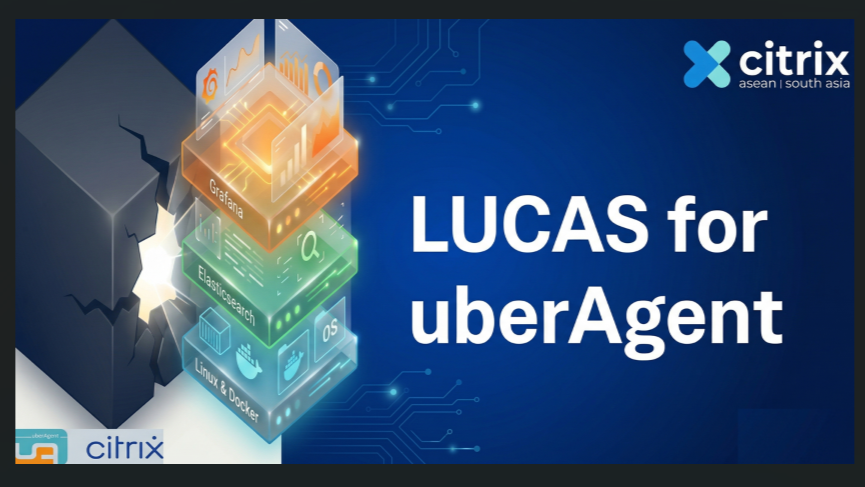
LUCAS is built on a Linux-based platform (Ubuntu) leveraging Docker container technology. Its core stack includes:
- Elasticsearch: Functions as the data processing and analytics engine, responsible for high-speed indexing, searching, and real-time analytics of collected endpoint data.
- Grafana: Acts as the visualization layer, delivering rich, interactive dashboards for monitoring performance and operational visibility.
Key Benefits of LUCAS
- Enterprise-Ready: A secure and reliable platform designed for high-intensity enterprise workloads.
- Deployment Flexibility: Supported on any hypervisor that runs Ubuntu and compatible with various public cloud platforms.
- Customization: Offers freedom to customize dashboards, fields, and filters to extend use cases beyond standard VDI monitoring.
- Management: Simplifies IT operations through easy deployment, responsive alerting, and expert assistance.

Data Insights and Operational Visibility
The combination of Citrix Experience Insights and LUCAS provides specific, actionable metrics across the IT environment. Examples of monitored data points include:
- Logon Performance: Detailed tracking of logon duration per user and per host to identify bottlenecks.
- Resource Utilization: Monitoring of RAM usage per application (e.g., Microsoft Edge, Citrix Workspace, Windows Search).
- Network Metrics: Real-time tracking of network throughput (KB/s) per application to identify high-bandwidth consumers.
Deployment and Managed Services
Citrix Asean and South Asia has observability experts, backed by OEM support, who can help customers and partners with:
- Deployment: Simultaneous rollout of the LUCAS appliance (on-premise or cloud) and Citrix Experience Insights across the endpoint fleet.
- Customization: Tailoring of dashboards and filters to meet specific organizational needs.
- Training: Knowledge transfer regarding dashboard navigation and visualization tools.
- Managed Services: Proactive monitoring and event management aimed at rapid issue resolution and disaster prevention.