There’s a moment every Citrix administrator dreads: Monday morning, 8 AM, 500 virtual desktops booting simultaneously, and the storage array quietly giving up on life.
It’s called a boot storm. And the hypervisor you choose determines whether it’s a routine Monday or an incident ticket.
Most IT leaders spend heavily on Citrix licensing, SAN arrays, and network upgrades, then run it all on a generic hypervisor. That’s where the waste hides.
The Platform Built for the Job
XenServer is the only hypervisor built by the same engineering team that builds the VDI layer it runs. That’s not a marketing line. It shows up in two features that change the economics of desktop virtualization entirely.
Intellicache shifts the read load for your master desktop image away from your expensive shared storage array onto local SSDs inside each host. When 200 desktops on the same server need the same OS block, they share one cached copy, the storage array barely notices. The practical result: organizations routinely downgrade their storage tier saving significantly on what is typically the most expensive line item in a VDI bill of materials.
PVS-Accelerator does the same thing for network traffic in Provisioning Services environments. Instead of hundreds of desktops simultaneously streaming OS images across the network, the hypervisor intercepts those requests locally and serves them from cache. Large enterprise deployments consistently cite this as the single feature that made scaling to thousands of seats viable without a network infrastructure overhaul.
One coherent I/O strategy. Built into the hypervisor, not bolted on.
What This Actually Costs You, Or Saves You?
The hardware savings are real and calculable. Lower-IOPS shared storage becomes viable. Network infrastructure scales more conservatively. VM density per host increases, meaning fewer physical servers to buy, rack, power, and cool.
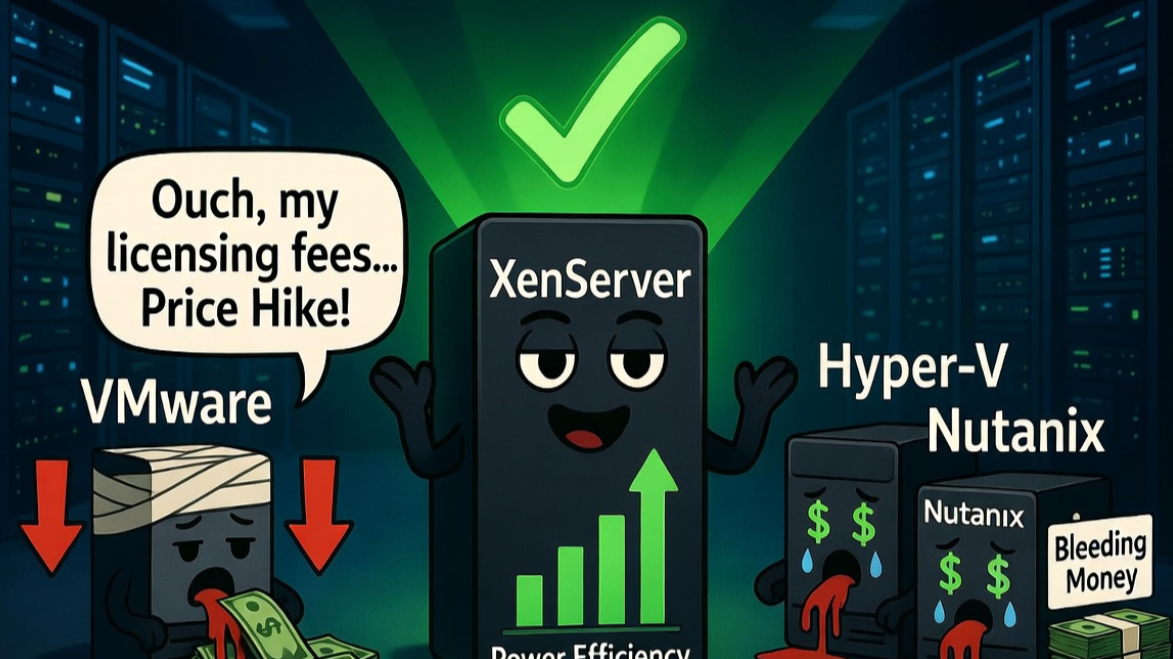
On licensing, the comparison with VMware has sharpened considerably since Broadcom’s 2023 acquisition. Customers report price increases of 2-3x, in some cases more, as perpetual licenses gave way to subscription bundles with 72-core minimums. For Citrix shops specifically, XenServer Premium Edition is included with Citrix Licenses. Many organizations are already entitled to it and don’t know it.
The operational savings are harder to put in a spreadsheet but easier to feel. Machine catalog updates that consumed an entire business day on unoptimized hypervisors complete in hours. Fewer storage escalations. Fewer Monday morning calls.
74% of IT leaders are currently evaluating VMware alternatives, according to Gartner’s Peer Community. The migration tooling has caught up, XenServer’s Conversion Manager handles VMware-to-XenServer transitions with direct disk conversion support, and the path for Citrix PVS environments is well-documented.
The best VDI platform isn’t the one with the longest feature list. It’s the one that makes expensive infrastructure unnecessary.